
The cultural shift behind vibe coding is significant. Programming has historically been defined by syntax mastery, language-specific idioms, and the ability to hold complex data structures in working memory. Vibe coding inverts that model. The developer describes intent, the agent produces implementation, and the developer reviews the result. It is closer to directing than typing.
The numbers reflect that shift. According to GitHub and industry surveys, 92% of US-based developers now use AI coding tools in some form. The phrase "vibe coding" itself has crossed 110,000 monthly searches, indicating that the concept has moved well beyond the early-adopter phase into everyday developer vocabulary.
How vibe coding works: describe, generate, iterate, ship
The vibe coding loop follows four steps. First, the developer describes the desired behavior in plain English: "Add a settings page with dark mode toggle and language selector." Second, the AI agent generates the implementation, scaffolding files, components, routes, and logic. Third, the developer reviews the output, runs it, and iterates with follow-up prompts to refine behavior. Fourth, the code ships after review and testing.
This loop works because modern AI agents understand project context. They read existing files, follow established patterns, and generate code that fits the surrounding architecture. The best agents propose changes as diffs rather than dumping raw code blocks, which makes review faster and safer.
The critical difference between vibe coding and simply asking an AI for code snippets is scope. Vibe coding agents operate across multiple files, understand dependencies, and can scaffold entire features. A chat-based snippet generator helps with isolated questions. A vibe coding agent helps build working software.
Where vibe coding works well
Vibe coding is most effective for tasks with well-understood patterns. When the problem space is standard and the expected output is predictable, AI agents produce reliable results quickly.
Prototypes and MVPs
Rapid scaffolding of working apps from descriptions. A natural language prompt can produce a functional prototype in minutes instead of hours.
CRUD endpoints
Standard REST and GraphQL APIs from data model descriptions. These follow well-established patterns that agents handle reliably.
UI scaffolding
Layouts, forms, and components from visual descriptions. Agents produce consistent markup and styling when given clear structural prompts.
Test generation
Test files with assertions from behavior descriptions. Agents can generate comprehensive test coverage for existing code faster than manual writing.
Configuration
Docker, CI/CD, and environment files from infrastructure needs. Boilerplate configuration is a strong fit for natural language generation.
Scripts and automation
One-off scripts, data processing, and CLI tools. These self-contained tasks benefit from fast generation and immediate testing.
Where vibe coding breaks down
Complex state management is the first boundary. Applications with deeply nested state, concurrent updates, race conditions, or nuanced lifecycle dependencies produce subtle bugs when generated by AI. The agent may write code that looks correct but fails under real-world timing and load conditions.
Performance-critical code is another weak point. Algorithms that need careful optimization, memory management, or hardware-aware tuning require domain knowledge that agents approximate but rarely master. The generated solution may work, but it may also be orders of magnitude slower than a hand-tuned implementation.
Domain-specific business logic exposes the limits of pattern matching. When the rules are unique to an organization, undocumented, or dependent on edge cases that are not represented in training data, vibe coding produces plausible but incorrect implementations. The code compiles, runs, and passes superficial checks while silently violating business constraints.
Security requirements demand a level of adversarial thinking that current agents lack. Authentication flows, authorization boundaries, input sanitization, and cryptographic implementations need more than pattern completion. A vibe-coded auth layer may look standard while missing critical edge cases that an attacker would find.
Integration complexity is the final common failure mode. When a feature touches multiple external APIs, legacy systems, or undocumented internal services, the agent lacks the context to generate correct integration code. It fills gaps with reasonable guesses, and those guesses become bugs that surface in production.
The review gap: why vibe coding without diff review creates technical debt
The most dangerous pattern in vibe coding is accepting generated code without reading it. When the agent produces a working feature in seconds, the temptation is to click accept and move on. That speed advantage becomes a liability when the accepted code contains hidden complexity, unnecessary dependencies, or architectural decisions that conflict with the rest of the project.
The accumulation is gradual. Each unreviewed generation adds a small amount of code that the developer does not fully understand. Over weeks and months, the codebase becomes a patchwork of agent-generated logic that no one on the team has actually read. Debugging becomes harder because the mental model of the code diverges from the actual implementation.
Industry data suggests that over 60% of new code in many organizations is now AI-generated. That number will grow. The question is not whether to use vibe coding. The question is who reviews the output. Without inline diff review built into the workflow, vibe coding trades short-term speed for long-term fragility.
How to vibe code responsibly
Responsible vibe coding keeps the developer in the loop at every step. These five practices prevent the review gap from turning into technical debt.
Review every diff
Inspect each agent change before accepting. Inline diff review should be part of the IDE workflow, not an afterthought.
Test immediately
Run in terminal after every generation cycle. Do not stack multiple agent changes without verifying that the project still works.
Scope tightly
One feature per prompt, not entire apps. Smaller prompts produce more predictable output and make review manageable.
Commit frequently
Git checkpoints after each verified change. If a later generation breaks something, you can roll back to a known good state.
Understand before shipping
Read the code the agent wrote before it reaches production. If you cannot explain what a function does, do not ship it.
How CodeWinger makes vibe coding safer
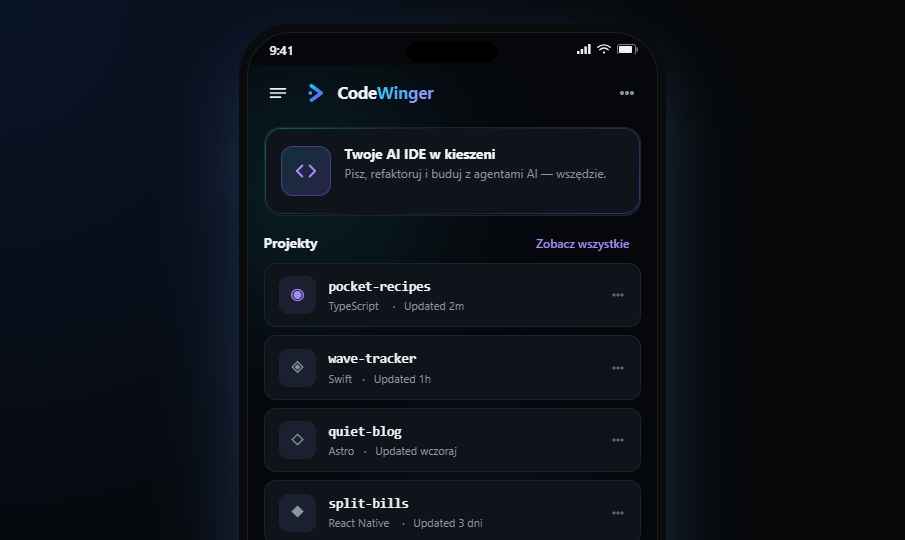
CodeWinger is built for developers who want the speed of vibe coding with the control of a professional IDE. The workflow keeps the agent close to the project while the developer stays close to the diff.
- Inline diff review shows every agent change as a reviewable diff before it lands in the project.
- Terminal and preview let you test immediately after each generation cycle without leaving the IDE.
- BYOK gives you direct control over which model provider processes your prompts and code.
- Git built in provides staging, commits, and rollback close to the editing flow for frequent checkpoints.
- Local-first privacy keeps your project files on your machine without routing code through an unnecessary backend.
The result is a vibe coding workflow where the agent handles generation and the developer handles judgment. Speed without sacrificing review.
Try it
Download CodeWinger Desktop for Windows x64
CodeWinger Desktop 0.3.0 is available free today. Use the setup installer for the normal Windows installation path. The MSI is available for administrators or managed deployments.
Bottom line
Vibe coding is real, it works, and it is not going away. The developers who benefit most from it are the ones who treat AI-generated code with the same rigor they apply to code written by a junior teammate: review the diff, run the tests, understand the logic, and commit only what you trust.
CodeWinger is designed for that workflow. The agent generates, the developer reviews, and the project stays under control.
FAQ
What is vibe coding?
Building software by describing it in natural language. Coined by Andrej Karpathy in 2025, adopted by 92% of US developers by 2026.
Is vibe coding good for production code?
For standard patterns (CRUD, UI, tests), yes with review. For complex business logic, security, and performance, vibe coding needs manual refinement and rigorous review.
What tools do I need for vibe coding?
An AI IDE with agent editing and diff review, an API key (BYOK), and a terminal for testing. CodeWinger provides all three for free.
Is vibe coding replacing developers?
No. It replaces routine typing, not thinking. Developers still review, test, debug, and architect. Vibe coding makes the 80% faster; developers handle the 20% that requires judgment.
How do I vibe code safely?
Review every diff, test in terminal, scope prompts tightly, commit frequently, and understand the code before shipping.
Can I vibe code with CodeWinger?
Yes. CodeWinger's agent accepts natural language prompts, shows changes as reviewable diffs, and includes terminal and Git for testing and committing.