
The shift from writing code to describing intent is the defining change in developer workflow this decade. Instead of translating requirements into syntax, developers now translate requirements into prompts and review the generated output. The role has not disappeared. It has moved from authoring to directing and verifying.
Platforms like Replit, Vercel v0, and Bolt.new demonstrated that non-technical users can create functional apps through conversation. For professional developers, natural language prompts now handle scaffolding, CRUD endpoints, test generation, and configuration. The question is no longer whether natural language programming works. The question is where it works well and where it needs human intervention.
Where natural language programming works today
UI scaffolding
Describing a layout, form, or component and getting working HTML/CSS/React output. Natural language excels here because the intent is visual and the correctness is easy to verify.
CRUD endpoints
Specifying data models and API behavior in English for standard REST or GraphQL endpoints. The patterns are well-established, and AI agents handle them reliably.
Test generation
Describing expected behavior and getting test files with assertions and edge cases. Prompts like "test that the user cannot submit an empty form" translate directly into code.
Configuration files
Describing infrastructure needs for Docker, CI/CD, and environment config. These files follow rigid formats where natural language maps cleanly to structure.
Documentation and comments
Generating API docs, README sections, and inline comments from code context. Natural language input produces natural language output with high accuracy.
Refactoring
Describing the desired change pattern and letting the agent apply it across files. "Rename all instances of UserDTO to UserResponse" is unambiguous and well-suited to NLP.
Where natural language programming breaks down
Natural language is inherently ambiguous. That ambiguity is manageable for standard patterns but becomes a liability in areas where precision determines correctness.
Complex state management. Natural language descriptions struggle to capture state transitions, race conditions, and edge cases. Saying "handle the loading state" does not specify what happens when two requests overlap, when the component unmounts mid-request, or when the cache is stale. The gap between the prompt and the required implementation grows with complexity.
Performance-critical code. English descriptions do not capture algorithmic constraints, memory management, or optimization requirements. "Make the search fast" does not distinguish between indexing strategies, caching layers, or query optimization. Performance work requires precise technical vocabulary that natural language prompts rarely provide.
Domain-specific logic. Business rules, financial calculations, and compliance logic need precision that natural language often lacks. "Calculate the tax" does not specify jurisdiction, rounding rules, exemptions, or edge cases. These domains have their own formal languages for a reason.
Security requirements. Natural language prompts rarely specify input validation, authentication checks, or encryption requirements explicitly enough. A prompt that says "create a login endpoint" may produce functional code that lacks rate limiting, password hashing, CSRF protection, or session management. Security is defined by what the code prevents, and English prompts tend to describe what the code should do.
Integration complexity. Connecting multiple systems with specific protocols, error handling, and retry logic exceeds what English prompts convey well. "Connect to the payment API" does not specify webhook verification, idempotency keys, timeout handling, or partial failure recovery. Integration code lives in the details that natural language abstracts away.
Why review infrastructure matters more when prompts replace code
When developers write code by hand, they understand every line because they authored it. When prompts generate code, the developer must verify implementation they did not write. This is a fundamentally different cognitive task. Reading code for correctness is harder than writing code with intent, and the volume of generated code can exceed what a developer would write manually in the same time.
Inline diff review becomes the primary quality gate. Every line must be inspected for correctness, security, and alignment with the prompt's intent. A good review workflow shows exactly what changed, highlights potential issues, and lets the developer accept, modify, or reject changes at the line level. Without this infrastructure, natural language programming creates a false sense of productivity.
Terminal testing is the second gate. Running the generated code catches issues that visual diff review misses: runtime errors, integration failures, performance problems, and incorrect behavior under real conditions. The combination of diff review and terminal verification is what makes natural language programming viable for production work.
The hybrid reality: natural language for intent, code for precision
In practice, natural language programming handles the 80%: scaffolding, boilerplate, standard patterns, configuration, and documentation. Developers still write the remaining 20%: critical business logic, security implementations, performance-sensitive code, and complex integrations. The best workflows combine both approaches rather than choosing one.
The developers who get the most from natural language programming are those who know when to prompt and when to type. They use English to generate a first draft, then refine the output manually where precision matters. This hybrid approach is faster than writing everything by hand and more reliable than trusting prompts for everything.
The tooling that supports this hybrid workflow matters. An IDE that shows generated changes as reviewable diffs, provides terminal access for testing, and keeps Git control with the developer creates the right environment for natural language programming to work safely at scale.
Where CodeWinger fits
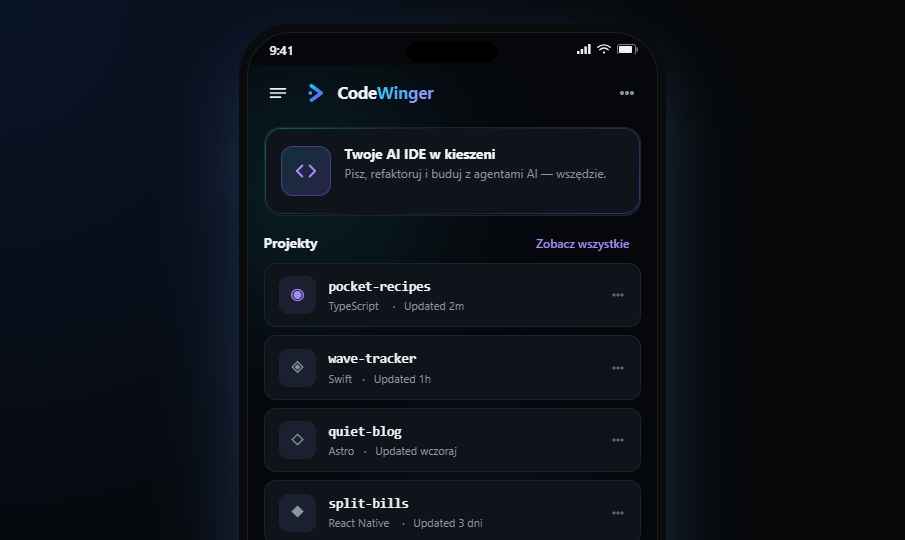
CodeWinger is built for the natural language programming workflow. The agent accepts English prompts, generates code changes, and presents them as reviewable diffs. The developer inspects every change before it reaches the repository.
Diff review is especially critical for NLP-generated code because the developer did not author the implementation. CodeWinger's inline diff view makes verification the default step, not an afterthought.
- Natural language input. Describe what you want in English. The agent generates the implementation.
- Inline diff review. Every generated change is shown as a diff. Accept, modify, or reject at the line level.
- Terminal verification. Run the generated code immediately to catch runtime issues.
- Local-first architecture. Your prompts and code stay on your machine. No cloud relay.
- BYOK (Bring Your Own Key). Connect your own API key. Prompts describing proprietary logic only reach your chosen provider.
- Git integration. Stage, commit, and manage branches without leaving the IDE.
Try it
Download CodeWinger Desktop for Windows x64
CodeWinger Desktop 0.3.0 is currently free. The setup installer is the recommended download for normal Windows users.
Bottom line
Natural language programming is a production reality in 2026. It works well for scaffolding, CRUD, tests, configuration, and documentation. It breaks down for complex state, performance, security, domain logic, and integrations. The developers who benefit most use it as a starting point, not an endpoint, and rely on inline diff review and terminal testing to verify every generated line.
FAQ
What is natural language programming?
Describing software behavior in English and letting an AI agent generate the implementation code. In 2026, this is a production workflow used by millions of developers.
Can I build a complete app with English prompts?
For standard apps (CRUD, UI, configurations), yes. For complex systems with custom business logic, security requirements, and performance constraints, natural language prompts need manual refinement.
Is natural language programming replacing traditional coding?
Not replacing, but augmenting. NLP handles scaffolding and standard patterns. Developers still write and review critical logic, security code, and performance-sensitive implementations.
Why is code review more important with AI-generated code?
Because the developer did not write the code line by line. Every generated line needs verification for correctness, security, and alignment with intent. Inline diff review is the primary quality gate.
What tools support natural language programming?
Most agentic IDEs (Cursor, Windsurf, CodeWinger) and coding agents (Claude Code, Copilot) accept natural language prompts. The key differentiator is the review infrastructure around the generated output.
How does CodeWinger handle natural language programming?
CodeWinger accepts natural language prompts and generates code changes shown as reviewable diffs. Local-first architecture and BYOK ensure prompts describing proprietary logic only reach your chosen provider.