
This is different from autocomplete, which predicts the next token inside a file, and from chat, which answers questions but does not touch the project. An agentic IDE closes the loop: the agent acts, the project changes, and the developer inspects real output.
Self-correction is the key signal. An agentic tool does not stop at the first error. It reads build failures, test output, and linter warnings, then adjusts its approach. That feedback loop is what separates an agent from a suggestion engine.
Criteria for evaluating agentic IDEs
Agent scope
Can the agent read, write, and refactor across multiple files in a single task?
Tool access
Does the agent use terminal, LSP, package managers, and build tools?
Review mechanism
Can you inspect every change as a diff before accepting?
Self-correction
Does the agent read errors and iterate, or stop at the first attempt?
Context depth
How much project context does the agent see? Files, dependencies, test results?
Rollback path
Can you reject agent changes cleanly and return to the previous state?
The agentic IDE landscape in 2026
The market has split into three categories. CLI agents like Claude Code and OpenCode run in the terminal and operate on the project through shell commands. Full IDEs like Cursor and Windsurf embed the agent directly into the editor with multi-file editing, inline diff, and integrated tools. Extensions like GitHub Copilot and JetBrains AI Agent add agentic features on top of existing editors.
According to recent industry surveys, 91% of engineering organizations now use AI-assisted development tools. The question is no longer whether to use AI in the IDE but how much autonomy to give the agent and how to keep the developer in control of the result.
Each category has tradeoffs. CLI agents are powerful but lack visual diff review. Full IDEs offer the tightest integration but can lock you into a specific editor. Extensions preserve your existing setup but often have limited agent scope compared to purpose-built tools.
The agentic control problem: more autonomy demands better guardrails
The more autonomous an agent becomes, the more important the review layer is. An autocomplete suggestion affects one line. An agent task can touch dozens of files, install dependencies, modify configuration, and run scripts. The blast radius is larger, and the developer needs stronger tools to inspect what happened.
This is the agentic control problem: agent power and developer oversight must scale together. A tool that gives the agent more autonomy without giving the developer better diff review, terminal visibility, and rollback is moving in the wrong direction.
The best agentic IDEs solve this by making review a first-class part of the workflow. Every file change appears as an inline diff. Terminal output is visible. Git state is accessible. The developer can accept, reject, or modify any part of the agent's work before it becomes permanent.
Why local-first agentic IDEs reduce risk
A local-first agentic IDE keeps all execution on the developer's machine. Files are read and written locally. Terminal commands run in the local shell. There is no cloud sandbox executing code on your behalf, which means no surprises from environments that differ from your actual setup.
Diff review acts as the gatekeeper. The agent proposes changes, and the developer sees exactly what will be written before it lands. This is the same principle that makes pull request review work, applied at the speed of the agent loop.
BYOK (bring your own key) adds another layer of control. Instead of routing all prompts through a vendor's API with their pricing and data policies, the developer connects directly to the model provider. This keeps billing transparent, model choice flexible, and data flow under the developer's control.
Where CodeWinger fits
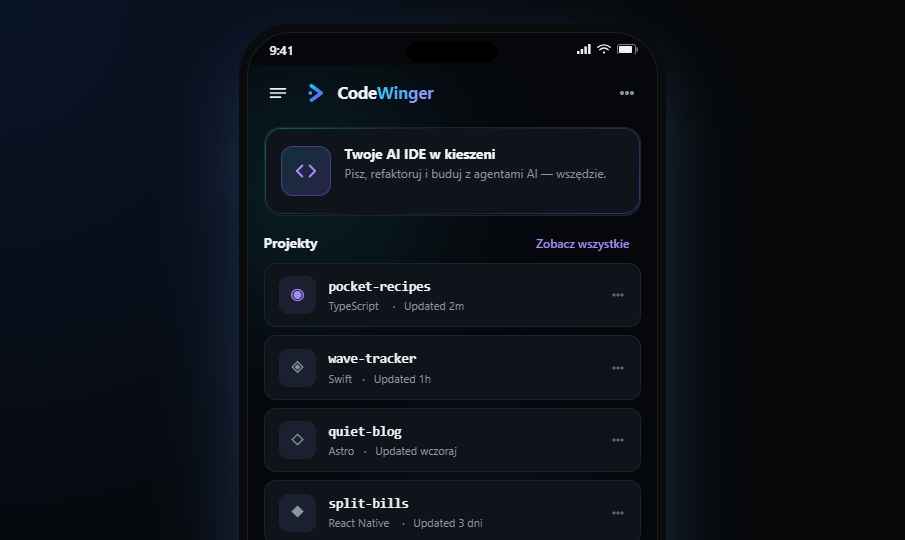
CodeWinger follows a clear agentic loop: the agent proposes file changes, the developer reviews the diff, runs commands in the terminal, and makes Git decisions. Every step is visible. Nothing lands without review.
This makes CodeWinger a local-first agentic IDE built for developers who want agent speed without giving up control. Key features:
- Agent-proposed file changes with inline diff review
- Integrated terminal for build, test, and script execution
- Git integration for commit, branch, and rollback control
- BYOK model access: connect your own API keys to OpenAI, Anthropic, or other providers
- Local-first architecture: all files and execution stay on your machine
- Free to download and use (CodeWinger Desktop 0.3.0)
Try it
Download CodeWinger Desktop for Windows x64
CodeWinger Desktop 0.3.0 is currently free. The setup installer is the recommended download for normal Windows users.
The bottom line
The best agentic IDE is the one where agent speed and developer control are balanced. An agent that can execute multi-step tasks is only useful if the developer can review every change, inspect terminal output, and roll back cleanly when something goes wrong.
The question to ask is not "which IDE has the most autonomous agent?" but "which IDE gives me the best tools to review and control what the agent does?" That is the difference between a productivity tool and a liability.
FAQ
What is an agentic IDE?
An IDE where the AI agent can autonomously execute multi-step tasks: reading files, making changes, running commands, reading errors, and iterating — while the developer reviews and approves each change.
What is the best agentic IDE in 2026?
It depends on priorities. Cursor for multi-file editing power, Claude Code for CLI-based quality, Copilot for ecosystem breadth. For local-first BYOK workflow, CodeWinger offers agentic editing with developer control.
How is an agentic IDE different from an AI code assistant?
An AI assistant suggests code in response to prompts. An agentic IDE executes tasks: reading context, making changes across files, running tests, and iterating based on results.
Is agentic coding safe?
It depends on the review workflow. Agentic coding with inline diff review, terminal verification, and Git discipline is safer than auto-accepting agent output without inspection.
Do I need an agentic IDE or is VS Code enough?
VS Code with AI extensions works for autocomplete and chat. An agentic IDE is more useful when you want the agent to execute multi-step tasks with review, terminal, and Git in one loop.
Is CodeWinger an agentic IDE?
Yes. CodeWinger's agent proposes file changes, the developer reviews diffs, runs terminal commands, and makes Git decisions. It is a local-first agentic IDE with BYOK model access.