
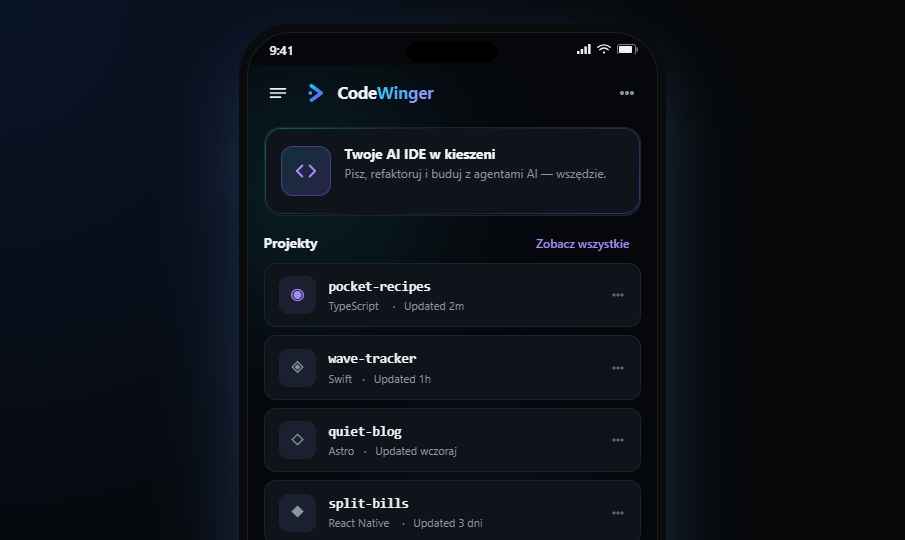
Autocomplete and chat changed how developers write code. Agents are changing a different part of the workflow: moving from intent to a set of project changes. That shift is powerful, but it also creates new review work.
The best setup is not a fully autonomous black box. It is a controlled loop where the AI can do useful work, the developer can inspect the result, and the repository does not become a mystery.
What is an AI code assistant?
An AI code assistant is usually strongest at local help: autocomplete, inline suggestions, explaining code, generating snippets, answering questions, and editing a selected block. It improves the speed of thinking and typing.
Assistants are useful because they stay lightweight. You ask a question, get a suggestion, and decide what to do. The tradeoff is that they often rely on you to move the work through the rest of the development loop.
What is an AI coding agent?
An AI coding agent is more operational. It can take a goal, inspect project context, decide which files matter, prepare edits, use tools, run terminal commands, respond to failures, and produce a reviewable result.
That makes agents better for multi-step tasks, but also more sensitive to product design. If the tool hides the plan, the diff, or the command output, the developer can lose trust quickly.
AI coding agent vs AI code assistant
| Capability | Code assistant | Coding agent |
|---|---|---|
| Best for | Autocomplete, explanations, snippets, small edits. | Multi-file changes, task execution, fixes, tests, and iteration. |
| Context | Often focused on the current file, selection, prompt, or explicit references. | Usually works across the project and decides which files or tools matter. |
| Output | Suggestion, answer, snippet, or direct small edit. | Plan, file changes, command output, diffs, and follow-up iterations. |
| Risk | Lower blast radius, but more manual work for the developer. | Higher leverage, but higher need for review and constraints. |
| Required control | Good prompt context and careful acceptance of suggestions. | Plan review, inline diff review, terminal output, tests, and Git discipline. |
When a code assistant is enough
Use an assistant when the task is narrow and the answer is useful even without a full project operation. Examples include understanding unfamiliar code, asking for an API example, writing a regex, drafting a unit test for one function, or improving a small block.
Learning a codebase
Ask for explanations before you ask for changes.
Small edits
Use suggestions when the blast radius is obvious.
Syntax and examples
Assistants are excellent for quick recall and scaffolding.
Decision support
Use chat to compare options before implementation.
When you need a coding agent
Use an agent when the task spans multiple files or needs a feedback loop. Refactors, bug fixes, migrations, integration work, build fixes, and test-writing often benefit from an agent because the work is not just generating text. It is moving a project from one state to another.
The real requirement: reviewable agent work
A coding agent becomes useful when its work is reviewable. The developer should be able to inspect the plan, changed files, diff, terminal output, dependency changes, and Git state before accepting anything.
This is where IDE design matters. A local-first IDE with inline diff review gives the agent enough room to work while keeping the human close to the code. Without that review layer, agentic coding can feel fast in a demo and expensive in a real repository.
Where CodeWinger fits
CodeWinger is built for agent-assisted development inside a local-first IDE. The agent can propose file changes, but the developer reviews the diff, runs the project, checks Git, and decides what lands.
That makes CodeWinger closer to an agent workflow than a pure assistant. It is not trying to replace developer judgment. It is trying to shorten the path from task to reviewed change.
Try it
Download CodeWinger Desktop for Windows x64
CodeWinger Desktop 0.3.0 is currently free. The setup installer is the recommended download for normal Windows users.
FAQ
What is the difference between an AI coding agent and an AI code assistant?
An AI code assistant usually helps with suggestions, chat, explanations, or local edits. An AI coding agent can plan and execute a larger task across files, use tools, run commands, respond to errors, and produce a reviewable set of changes.
Are coding agents always better than code assistants?
No. Assistants are often better for quick explanations, autocomplete, small edits, and learning. Agents are more useful for multi-step work where planning, file changes, testing, and review need to happen together.
What should developers review when using a coding agent?
Developers should review the plan, changed files, inline diff, terminal output, test results, dependency changes, and Git state before committing agent-generated code.
Why do agents need terminal and Git access?
Terminal and Git access let an agent work inside the real development loop: running builds, tests, scripts, checking changes, and preparing work that the developer can review.
Can an AI coding agent replace a developer?
No. A coding agent can accelerate implementation, but the developer still owns requirements, architecture, review, testing, security, and the decision to merge or ship.
Where does CodeWinger fit in this comparison?
CodeWinger is designed for agent-assisted development in a local-first IDE: the agent proposes changes, the developer reviews the diff, and terminal, Git, LSP, live preview, and BYOK stay in one workspace.