
VS Code has an enormous extension ecosystem, and for many developers that is the right starting point. Extensions are familiar, fast to try, and often enough for chat, autocomplete, explanations, or small changes.
The question changes when AI starts acting like an agent. At that point, the tool is not only answering questions. It is proposing changes to a real project. That workflow needs stronger boundaries around what changed, what ran, what failed, what is staged, and what the developer accepts.
When a VS Code AI extension is enough
A VS Code extension is a good fit when you want AI inside a workflow you already trust. If the work is mostly explanation, autocomplete, quick snippets, or focused local edits, the extension model is convenient.
Extensions also make sense when your team has already standardized on VS Code, settings sync, extension policies, dev containers, or a specific toolchain. In that case, changing the whole IDE may be unnecessary for light AI assistance.
When a dedicated AI IDE makes more sense
A dedicated AI IDE makes more sense when the product is designed around the agentic loop from the beginning. The agent can propose multi-file changes, but the IDE also gives the developer review surfaces: diffs, terminal output, Git status, preview, diagnostics, and project context.
This matters because agentic coding is not just code generation. It is a process: understand the request, inspect the project, change files, run commands, react to failures, review diffs, and commit intentionally.
Agent edits
The agent works across files instead of only suggesting snippets in chat.
Diff review
The developer sees exactly what changed before accepting work.
Terminal and Git
Build output, tests, scripts, status, staging, and commits stay close to the edit.
Local-first control
The project remains centered on the local machine, with explicit BYOK model access.
AI IDE vs VS Code extension
| Decision point | VS Code AI extension | Dedicated AI IDE |
|---|---|---|
| Best for | Chat, autocomplete, explanations, small edits, and staying in an existing setup. | Agent-heavy work with review, terminal feedback, Git state, preview, and local project control. |
| Workflow depth | Adds AI to the current editor workflow. | Designs the whole editor around AI-assisted implementation. |
| Review surface | Depends on extension behavior and existing editor features. | Should make diffs, changed files, terminal output, and Git decisions first-class. |
| Model access | Often tied to the extension's account or provider configuration. | Can be designed around explicit BYOK provider keys and local-first control. |
| Tradeoff | Maximum familiarity and ecosystem flexibility. | More focused agent workflow with less context switching. |
Decision checklist
Choose based on the shape of your work, not the label on the tool. If your AI usage is mostly small help, an extension can be enough. If your AI usage is becoming implementation work, review and control become the product.
| Ask this | If yes, lean toward |
|---|---|
| Do you mostly need autocomplete, chat, or explanations? | VS Code AI extension |
| Do AI changes often span multiple files? | Dedicated AI IDE |
| Do you need inline diff review before accepting code? | Dedicated AI IDE |
| Do terminal output, tests, preview, and Git state drive the work? | Dedicated AI IDE |
| Is your team already standardized on one editor and extension policy? | VS Code AI extension |
| Do you want local-first workflow and explicit BYOK model access? | Dedicated AI IDE |
Where CodeWinger fits
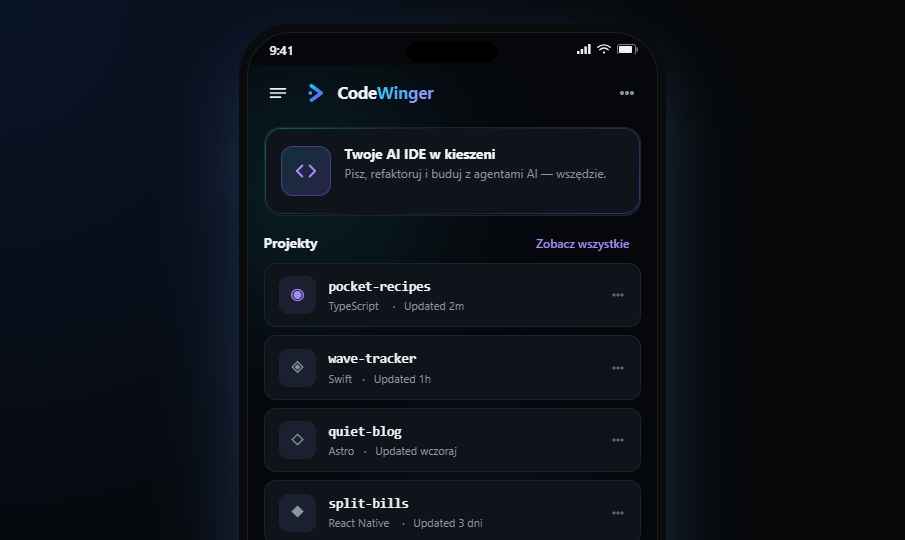
CodeWinger is built as a dedicated local-first AI IDE rather than a thin chat add-on. It brings agent editing, inline diff review, terminal, Git, LSP, live preview, and BYOK provider keys into one Windows x64 desktop workspace.
That does not mean every developer should abandon their existing editor. It means CodeWinger is aimed at the moment where AI-assisted work becomes a project workflow, not just a suggestion box.
Try it
Download CodeWinger Desktop for Windows x64
CodeWinger Desktop 0.3.0 is currently free. The setup installer is the recommended download for normal Windows users.
FAQ
Is a VS Code AI extension enough for most developers?
A VS Code AI extension can be enough for autocomplete, chat, explanations, and small edits. A dedicated AI IDE becomes more useful when the workflow needs agent editing, inline diff review, terminal feedback, Git state, preview, LSP, and BYOK in one place.
What is the difference between an AI IDE and an AI extension?
An AI extension adds AI capabilities to an existing editor. An AI IDE is designed around the full AI-assisted development loop, including local project context, agent edits, review, terminal, Git, preview, and model access.
When should developers choose a dedicated AI IDE?
Developers should consider a dedicated AI IDE when AI work spans multiple files, requires terminal feedback, needs visible diffs, touches Git state, or must be reviewed carefully before changes land.
Does an AI IDE replace VS Code?
Not necessarily. Some developers prefer VS Code plus extensions. Others use a dedicated AI IDE for agent-heavy tasks where review, terminal, Git, and local-first control need to be tightly integrated.
Why does local-first design matter in this comparison?
Local-first design keeps the project workspace centered on the developer's machine, which makes file access, diff review, terminal output, Git state, and credential handling easier to reason about.
Where does CodeWinger fit?
CodeWinger is a dedicated local-first AI IDE with agent editing, inline diff review, terminal, Git, LSP, live preview, and BYOK provider keys for developers who want more than a chat add-on.