
Most developers already write some form of specification before building a feature: a ticket, a design doc, a set of requirements. Spec-driven development formalizes that habit for AI workflows. Instead of describing a task in a chat prompt and hoping the agent infers the right boundaries, you write a structured spec file that lives in the project directory. The agent reads it, follows it, and the developer validates output against it.
The key difference from traditional documentation is persistence. A prompt disappears when the context window fills up or the session ends. A spec file stays in the project. It can be referenced across multiple agent sessions, shared with teammates, and used as the single source of truth for what a feature should do and how the implementation should be verified.
Why agents work better with specs
Specs reduce hallucinations by defining boundaries. When an agent receives a vague prompt like "refactor the auth module," it has to guess which files matter, which patterns to follow, and where to stop. A spec removes that guesswork. It says exactly which files to modify, which functions to change, and which areas are off-limits. Clear scope means the agent stays within bounds instead of inventing work that was never requested.
Specs make output testable. If the spec defines concrete acceptance criteria — specific behaviors, return values, error handling, or edge cases — the developer can verify agent work objectively. Without acceptance criteria, review becomes subjective: does the code "look right"? With a spec, review becomes mechanical: does the output satisfy the defined conditions?
Specs survive context resets. Large agent sessions accumulate thousands of tokens of conversation history. When the context window fills or a session ends, that history is gone. But a spec file remains in the project directory, ready for the next session. The new agent instance picks up exactly where the previous one left off, guided by the same spec, without needing the developer to re-explain the task.
Specs are shareable. Multiple developers working on the same feature can reference the same spec. Multiple agent sessions — whether sequential or parallel — can follow the same document. This makes spec-driven development especially useful for teams, where consistency across contributors matters more than individual speed.
Anatomy of a good spec for AI coding agents
Objective
What the feature or fix should accomplish, in one or two sentences. This anchors every decision the agent makes during implementation.
File scope
Which files and functions should be modified. Which files must not be touched. Explicit scope prevents the agent from wandering into unrelated parts of the codebase.
Constraints
Technical requirements, patterns to follow, libraries to use or avoid. Constraints encode team conventions that the agent would not otherwise know.
Acceptance criteria
Concrete conditions that define success. Testable, not vague. "The function returns an error when input is empty" is useful. "The code should be robust" is not.
Edge cases
Known boundary conditions the implementation must handle. Listing edge cases upfront prevents the agent from producing code that only works for the happy path.
Out of scope
What the agent should explicitly not do. Prevents scope creep and keeps the implementation focused on the defined task instead of adjacent improvements.
Chunked workflows: breaking features into agent-sized tasks
Large features do not fit cleanly into a single agent session. Context windows have limits. Attention degrades over long conversations. And reviewing a massive diff is harder than reviewing several small ones. Chunked workflows solve this by splitting a feature into sequential tasks, each scoped by a portion of the spec.
In practice, this means writing a prompt plan file alongside the spec. The prompt plan lists each chunk in order: what the agent should do first, what depends on the result of the first chunk, and what can be done independently. Each chunk references the relevant section of the spec, so the agent has just enough context to do focused work without being overwhelmed by the full feature scope.
The discipline of chunking also improves review quality. A developer can verify each chunk against its spec section before moving to the next. If the agent drifted on chunk two, the developer catches it before chunk three builds on a broken foundation. Smaller diffs, clearer specs, tighter feedback loops.
Using diff review and tests to validate against the spec
Diff review is the first validation layer. After the agent finishes a task, the developer inspects the changed files against the spec. Did the agent modify only the files listed in the file scope section? Did it follow the constraints? Does the diff reflect the stated objective without introducing unrelated changes? Inline diff review makes this check fast and visual.
Terminal-based tests are the second layer. If the spec includes acceptance criteria with testable conditions, those conditions should map to actual tests. Running the tests confirms whether the implementation satisfies the spec or whether the agent missed something. Tests defined in the spec are not just documentation — they are the verification step.
Git discipline ties it together. Each spec chunk should result in a clean commit. The commit message references the spec section. The diff is reviewable. The tests pass. If something breaks later, the team can trace the commit back to its spec and understand exactly what was intended. This makes spec-driven development compatible with existing code review and CI workflows.
Where CodeWinger fits
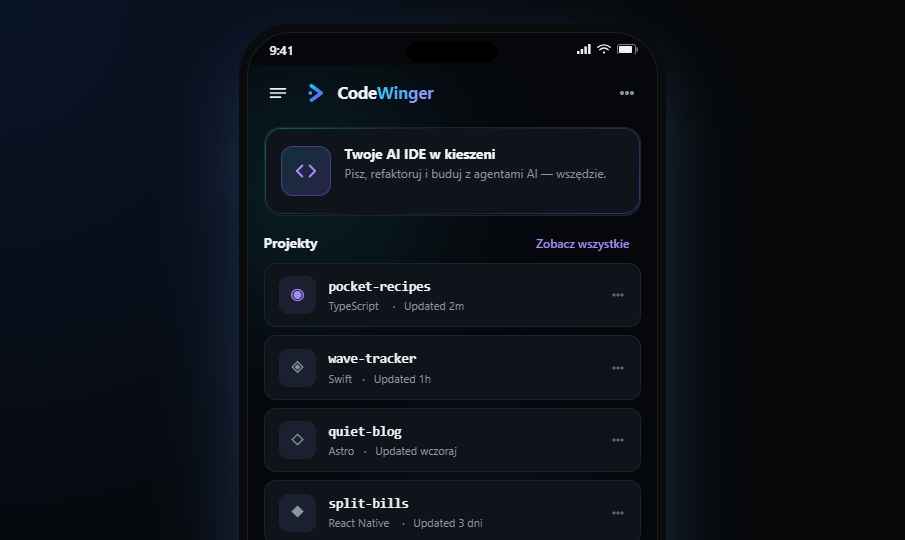
CodeWinger is designed around a local-first workflow where spec files, project context, and agent output stay grounded on the developer's machine. Several features align naturally with spec-driven development:
- Spec files as local project context. Spec files live in the project directory and are part of the agent's context. No external tool or cloud service required.
- Diff review as spec validation. Inline diff review lets developers check agent output against the spec before accepting changes into the codebase.
- Terminal integration for tests. Run acceptance tests defined in the spec directly from the IDE. Verify that the agent's implementation meets the criteria.
- BYOK model access. Use your own API key with the model that fits the task. Spec-driven workflows work with any model provider.
Try it
Download CodeWinger Desktop for Windows x64
CodeWinger Desktop 0.3.0 is currently free. The setup installer is the recommended download for normal Windows users.
Bottom line
Spec-driven development is not a new idea. Developers have written specs for decades. What changes with AI coding agents is that the spec becomes executable context — a document the agent reads and follows, not just something a human references. Writing the spec before the prompt gives the agent clearer scope, makes output testable, and keeps the developer in control of what gets built. The spec is the contract between the developer and the agent.
FAQ
What is spec-driven development?
Writing specification files before prompting an AI coding agent. Specs define what to build, which files to change, and how to verify the result.
Why do AI agents perform better with specs?
Specs provide clear boundaries, reduce hallucinations, make output testable, and persist across context window resets and sessions.
What should a spec include?
Objective, file scope, constraints, acceptance criteria, edge cases, and out-of-scope boundaries. The more concrete, the better the agent output.
What is a chunked workflow?
Breaking a large feature into sequential agent-sized tasks, each guided by a portion of the spec. This keeps context focused and output reviewable.
How do I validate agent output against a spec?
Review the diff against acceptance criteria. Run tests defined in the spec. Check that file scope boundaries were respected.
Can I use spec-driven development with CodeWinger?
Yes. Spec files live in your local project directory and are part of the agent's context. Diff review validates changes against the spec, and terminal integration runs spec-defined tests.