
The AI model landscape in 2026 is not a single-winner market. Claude produces some of the highest-quality code with low hallucination rates. GPT excels at structured reasoning and architectural planning. Gemini offers the largest context windows for working with massive codebases. Smaller, faster models like Haiku and Flash handle routine edits at a fraction of the cost. Treating all of these as interchangeable means leaving performance and money on the table.
Developers who use a single model for everything are optimizing for simplicity at the expense of results. A multi-model approach treats AI models the way experienced developers treat tools: you pick the right one for the job. The key requirement is an IDE that does not lock you into one provider, and that is where BYOK comes in.
Semantic routing: matching tasks to models
| Task type | Best model choice | Why |
|---|---|---|
| Code generation | Claude | Strongest code quality, lowest hallucination rate |
| Architecture planning | GPT | Strong reasoning, structured output |
| Long-context analysis | Gemini | Largest context window, good at large codebases |
| Quick fixes | Haiku / Flash | Fast, cheap, good enough for small edits |
| Documentation | Any | All models handle docs well; optimize for cost |
Semantic routing is the practice of directing each coding task to the model best suited for it. Instead of sending every prompt to the same expensive, high-capability model, you classify the task and route accordingly. A complex refactoring benefits from Claude's code generation strength. A quick variable rename does not need a premium model at all.
This does not require automated infrastructure. Even manual model switching in a BYOK IDE counts as semantic routing. The important thing is the habit: before sending a prompt, consider which model fits. Over time, this becomes second nature and pays dividends in both quality and cost.
Cost optimization through model selection
Token pricing varies dramatically across models and providers. A premium model like Claude Opus or GPT-4o might cost ten to twenty times more per token than a fast model like Haiku or Flash. If you use the premium model for every task, including trivial ones like renaming a variable or adding a log statement, you are burning budget on work that a cheaper model handles just as well.
The math is straightforward. If 60 percent of your AI coding tasks are simple edits, documentation, or boilerplate, routing those to a fast model can cut your total AI spending by 40 to 50 percent without any loss in output quality. The premium models stay reserved for the tasks that actually benefit from their capabilities: complex generation, multi-file refactoring, and deep reasoning.
This is only possible when you control your own API keys. Subscription-based IDEs charge a flat rate and choose the model for you. BYOK gives you the transparency to see exactly what each task costs and the freedom to optimize. Token-level billing means you pay for what you use, and model choice means you control how much each task costs.
BYOK as the multi-model enabler
Subscription-locked IDEs bundle one or two models behind a monthly fee. That is convenient, but it eliminates model choice. You cannot switch to Gemini for a large-context task or drop to Haiku for a quick fix. The vendor decides which model handles your prompts, and you pay the same regardless of whether the task needed a premium model or not.
BYOK changes the equation. With your own API keys from Anthropic, OpenAI, and Google, you can switch models per task. The IDE becomes a neutral interface that routes your prompts to whatever provider you choose. You keep billing visibility, model control, and the ability to add new providers as the market evolves.
This is not a minor feature. Multi-model workflows are only possible when the IDE does not gatekeep provider access. BYOK is the prerequisite for semantic routing, cost optimization, and the kind of flexible AI workflow that serious developers need in 2026.
Practical setup for multi-model coding
Get API keys from multiple providers
Anthropic, OpenAI, Google — set up accounts and billing with each provider you plan to use.
Configure keys in your IDE
Enter each provider's key in your BYOK settings. A good IDE stores them securely and lets you switch between them.
Match tasks to models
Use premium models for complex generation, fast models for quick fixes. Build the habit of choosing before prompting.
Monitor usage
Track token consumption per provider to optimize cost. Watch for tasks where a cheaper model would have been sufficient.
Review regardless of model
Diff review applies to all models. Quality varies; review does not. Every AI-generated change gets inspected before it enters your codebase.
What to watch for
Context transfer between models is the biggest practical challenge. If you start a task with one model and switch mid-conversation, the second model does not have the first model's context. Plan your model switches at natural breakpoints: between tasks, not mid-task. Keep prompts self-contained when possible so they work well regardless of which model processes them.
Token format differences can also cause surprises. Models tokenize text differently, which affects how much context fits in a single request. A prompt that fits comfortably in Gemini's large context window might need to be trimmed for a model with a smaller window. Be aware of each model's limits and adjust your prompts accordingly.
Finally, avoid over-optimization. The goal is not to find the theoretically perfect model for every micro-task. The goal is to avoid obvious mismatches: do not use an expensive premium model for trivial edits, and do not use a fast cheap model for complex multi-file refactoring. A rough heuristic applied consistently beats a perfect system that is too complex to follow.
Where CodeWinger fits
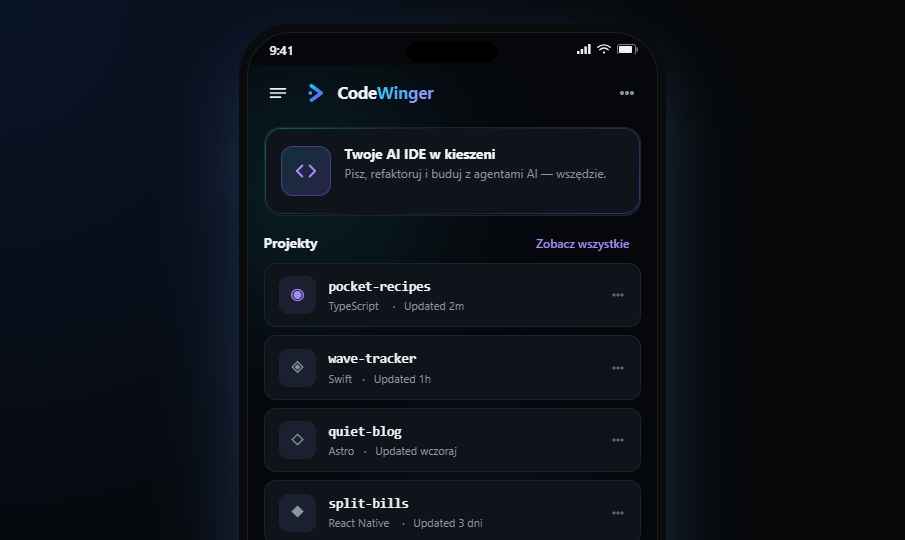
CodeWinger is built around a BYOK workflow, which means multi-model support is a natural extension. BYOK is the foundation that makes model switching possible. Instead of being locked into one provider, you bring keys from any supported provider and route tasks accordingly.
- Configure API keys from Anthropic, OpenAI, Google, and other providers in one place.
- Switch the active model per task based on complexity, context size, and cost.
- Keep billing transparent with token-level usage tied to your own provider accounts.
- Review every AI-generated diff before it enters your codebase, regardless of which model produced it.
- Stay local-first: project files, Git state, and workspace remain on your machine.
Try it
Download CodeWinger Desktop for Windows x64
CodeWinger Desktop 0.3.0 is currently free. The setup installer is the recommended download for normal Windows users.
Bottom line
Multi-model AI coding is not about chasing the newest model. It is about using the right model for the right task: premium models for complex work, fast models for simple edits, large-context models for big codebases. BYOK makes this possible by removing the vendor lock-in that subscription IDEs impose. The result is better code quality, lower costs, and more developer control.
FAQ
What is multi-model AI coding?
Using different AI models for different coding tasks based on their strengths. Claude for generation, GPT for planning, fast models for simple edits.
Why not just use one AI model?
Models have different strengths. One may be better at code generation, another at reasoning, another at handling large context windows. Multi-model gives you the best tool for each task.
Do I need BYOK for multi-model?
Yes. Subscription-locked IDEs restrict you to their bundled models. BYOK lets you bring keys from any provider and switch freely.
Is multi-model more expensive?
Not necessarily. Using cheaper models for simple tasks often reduces total cost compared to using a premium model for everything.
How do I switch models in CodeWinger?
Configure BYOK keys from different providers. Switch the active model per task based on complexity and requirements.
Does model switching affect code quality?
It can. Always review diffs regardless of which model generated the code. Quality varies by model and task type.