
BYOK is becoming a serious product decision for developer tools. A code editor that hides model access behind one subscription can be convenient. A BYOK AI IDE gives developers a different kind of power: the ability to decide which provider is used, which account is billed, and how credentials are handled.
That matters most when the IDE is not just answering questions. Once an AI agent can inspect files, propose edits, run commands, and help with real project work, developers need stronger boundaries around data, cost, review, and ownership.
What BYOK means in an AI IDE
In a typical BYOK setup, the IDE does not provide a hidden shared model account. Instead, the user adds a provider key for services such as OpenAI, Anthropic, Google Gemini, or another compatible model endpoint. The IDE uses that key when it sends requests to the selected model.
That does not mean every model runs locally. It also does not mean every prompt stays on the machine. BYOK answers a narrower question: whose provider account and credentials are being used when the IDE talks to an AI model?
A local-first AI IDE can pair well with BYOK because the project remains centered on the user's machine, while model access stays explicit and configurable. The workspace is local. The model connection is chosen by the developer.
Why developers care about BYOK
Developer teams care about BYOK because AI usage is no longer limited to occasional chat. Agentic coding can involve larger prompts, repository context, tool output, test logs, and multiple iterations. That makes provider policy, billing visibility, rate limits, and model selection much more important.
Model choice
Use the model that fits the task, budget, context window, latency, and company policy.
Billing control
Keep AI usage tied to your own provider account instead of an opaque tool bundle.
Credential ownership
Rotate, revoke, or replace keys without waiting for the IDE vendor to change its stack.
Team governance
Separate personal experiments from company work and align access with internal rules.
BYOK, privacy, and the local-first boundary
BYOK is not a magic privacy shield. If the IDE sends prompts, selected files, diffs, or terminal output to a cloud model, that information leaves the device and is handled by the selected provider under its terms and configuration.
The practical value of BYOK is transparency and control. Developers know which account is used, which provider receives requests, which model is selected, and where usage is measured. Combined with local-first project handling and inline diff review, BYOK can support a much more accountable AI coding workflow.
For sensitive repositories, the safest posture is simple: minimize what is sent, review what the agent changes, keep credentials out of source control, and use provider accounts that match the data sensitivity of the work.
A practical BYOK checklist for AI IDEs
| Question | What to look for |
|---|---|
| Where is the key stored? | Prefer OS credential storage, keychain integration, or a secure local secret store. Avoid project files and committed config. |
| Can the key be removed? | The IDE should make it easy to delete, replace, or rotate provider credentials. |
| Can I choose the model? | BYOK is more useful when it supports model selection, not just one hard-coded endpoint. |
| Can I see what the agent changed? | Provider control is not enough. You still need inline diff review before accepting generated changes. |
| Can I keep Git discipline? | The workflow should make it easy to inspect changed files, run tests, and commit only reviewed work. |
The point is not to make developers manage more complexity for no reason. The point is to avoid turning the AI layer into a black box inside the tool where model access, costs, and data handling are hard to reason about.
Where CodeWinger fits
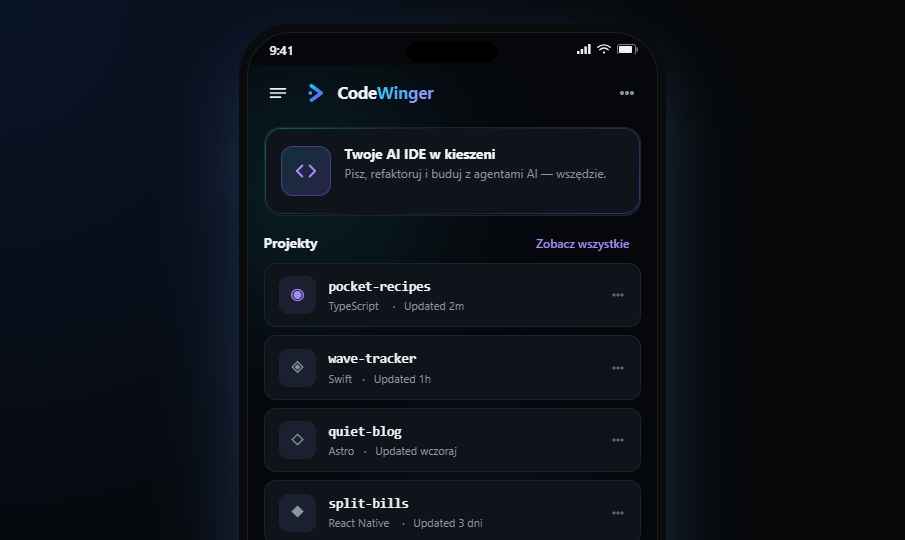
CodeWinger is designed around a local-first, BYOK-oriented workflow. The project stays local, the agent proposes changes, and the developer reviews the diff before accepting work into the codebase.
That combination is important. BYOK gives control over model access. Local-first design keeps the workspace grounded on the machine. Inline diff review keeps the developer responsible for what changes. Together, those choices make AI coding feel less like outsourcing judgment and more like accelerating implementation.
Try it
Download CodeWinger Desktop for Windows x64
CodeWinger Desktop 0.3.0 is currently free. The setup installer is the recommended download for normal Windows users.
FAQ
What does BYOK mean in an AI IDE?
BYOK means bring your own key. In an AI IDE, it usually means connecting your own model provider API key instead of relying on a bundled account controlled by the tool vendor.
Is BYOK more private than a bundled AI account?
BYOK can give developers clearer control over provider choice, billing, usage, and credential ownership. It does not automatically mean that no data leaves the device, because prompts may still be sent to the selected model provider.
Does BYOK mean the AI model runs locally?
No. BYOK and local-first are related but different ideas. BYOK is about whose API key is used. Local-first is about keeping the project workspace centered on the user's machine.
Where should AI API keys be stored?
API keys should not be committed to repositories or exposed in client-side code. A desktop AI IDE should store credentials through a secure local mechanism such as the operating system keychain or a dedicated secret store.
Why do developers want model choice in an AI IDE?
Model choice lets developers match the provider and model to the task, budget, latency, context size, and organization policy instead of being locked into one bundled AI account.
Does CodeWinger support a BYOK workflow?
Yes. CodeWinger is designed around a local-first, BYOK-oriented workflow where developers connect provider access, keep projects local, and review AI-generated changes before accepting them.