
AI coding agents are becoming better at planning and editing, but codebases are not plain documents. They contain symbols, types, dependencies, diagnostics, generated files, imports, references, and language-specific rules.
Language Server Protocol matters because it gives the IDE a standard way to ask language servers for this intelligence. The agent still needs human review, tests, and Git discipline, but LSP makes the workspace less opaque.
What Language Server Protocol does
LSP is a protocol that lets editors communicate with language servers. Instead of every editor reimplementing every language feature, a language server can provide intelligence for a language or framework, and the editor can consume those capabilities through a common interface.
For developers, the visible result is familiar: completion, diagnostics, hover details, go-to-definition, find references, document symbols, formatting, rename support, and code actions. These features feel ordinary now, but they are the difference between editing text and working with code.
Why AI coding agents need language intelligence
An AI agent can read files and propose changes, but raw text is a weak representation of a codebase. It can miss symbol relationships, type errors, imports, references, and diagnostics that a language-aware editor already sees.
LSP helps close that gap. It can show where a function is defined, where a type is referenced, whether a file has diagnostics, and whether a rename or edit is likely to ripple across the project. That does not make the AI infallible. It makes the review surface better.
Diagnostics
Catch language-level errors before they turn into mysterious runtime behavior.
Definitions
Move from a call site to the actual implementation the agent may need to modify.
References
Understand the blast radius before accepting a rename, signature change, or refactor.
Code actions
Use language-aware fixes and refactor support instead of guessing from text alone.
Text-only AI context vs LSP-backed IDE context
Prompt context is useful, but it is not the same as language intelligence. A prompt can include files, instructions, and snippets. LSP can tell the IDE what the language tooling sees right now.
| Workflow | What the developer gets |
|---|---|
| Text-only AI context | The agent reasons over supplied files, snippets, and instructions, but may miss current diagnostics, symbol relationships, or references. |
| LSP-backed IDE context | The workspace exposes diagnostics, definitions, references, hover details, completion, formatting, and rename support close to the edit. |
| Agent-only change | The AI proposes edits, but the developer must manually verify whether language tooling agrees. |
| Agent plus LSP review | The developer can inspect proposed changes against diagnostics, symbols, references, terminal output, Git state, and inline diffs. |
A practical LSP checklist for AI IDEs
When evaluating an AI IDE, do not only ask whether the tool has chat or an agent. Ask whether it keeps the core language tooling visible while AI edits are happening.
| Capability | Why it matters |
|---|---|
| Diagnostics | Shows type errors, syntax errors, and language-level warnings while the agent changes files. |
| Go-to-definition | Lets the developer inspect the real implementation before accepting edits. |
| Find references | Helps estimate blast radius for refactors, renames, and API changes. |
| Hover and completion | Keeps language details close to the edit instead of buried in documentation or chat. |
| Formatting and code actions | Reduces noisy diffs and supports language-aware fixes. |
| Inline diff review | Connects language intelligence to the actual changes the agent wants to land. |
Where CodeWinger fits
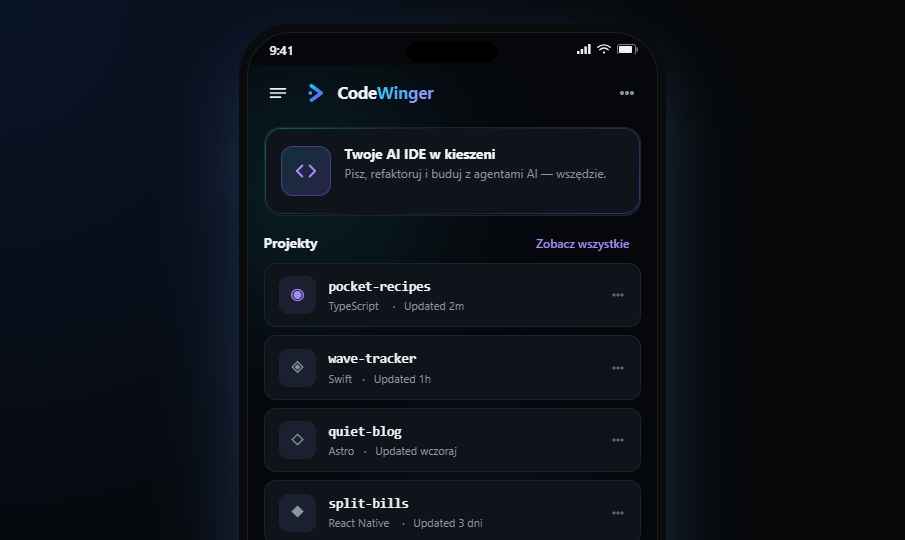
CodeWinger is built as a local-first AI IDE with agent editing, inline diff review, live preview, terminal, Git, LSP, and BYOK provider keys. LSP belongs in that stack because AI-assisted development still needs language-aware code intelligence.
The goal is not to turn LSP into a magic safety guarantee. The goal is to keep the agent, the editor, diagnostics, diffs, terminal feedback, and Git decisions in the same workflow so developers can move faster without giving up control.
Try it
Download CodeWinger Desktop for Windows x64
CodeWinger Desktop 0.3.0 is currently free. The setup installer is the recommended download for normal Windows users.
FAQ
What is LSP in an AI IDE?
LSP stands for Language Server Protocol. In an AI IDE, it provides structured language intelligence such as diagnostics, completion, hover, go-to-definition, references, formatting, and rename support.
Why does Language Server Protocol matter for AI coding agents?
AI coding agents need more than raw text. LSP helps ground the workflow in real symbols, diagnostics, references, and language-aware project context, which can reduce blind edits and improve review.
Is LSP the same as an AI model?
No. LSP is not an AI model. It is a protocol for language tooling. AI models generate or reason about changes, while LSP provides code intelligence from language servers.
Does LSP replace tests or diff review?
No. LSP supports better coding context, but developers should still review diffs, run tests, inspect terminal output, and check Git state before accepting AI-generated code.
What LSP features should an AI IDE expose?
A strong AI IDE should expose diagnostics, completion, hover, go-to-definition, references, formatting, rename support, and clear links between language intelligence and agent-generated changes.
Does CodeWinger include LSP?
Yes. CodeWinger is designed as a local-first AI IDE with agent editing, inline diff review, live preview, terminal, Git, LSP, and BYOK provider keys.