
Gartner's 2025-2026 surveys consistently show that the vast majority of engineering leaders believe AI coding tools improve their teams' output. The number is striking: roughly 9 out of 10 leaders say productivity is up. But belief is not measurement. When researchers run controlled studies comparing teams with and without AI assistance on identical tasks, the average net productivity improvement lands around 19.3%. The gap between perception and measurement matters because it shapes how organizations budget, plan sprints, and set expectations.
McKinsey's research adds a more specific lens. Their studies found that AI coding tools reduce routine coding time by approximately 46%. For an average developer, that translates to about 3.6 hours saved per week on tasks like writing boilerplate, generating standard patterns, and producing initial implementations. That is real value. It is also not 10x. Understanding the difference between 46% on routine tasks and overall net productivity is the key to using these tools honestly.
60% of code is AI-generated — what does that actually mean?
Multiple reports now estimate that around 60% of new code in AI-assisted workflows is initially generated by AI. That headline sounds transformative. But generated code is not the same as shipped code. The 60% figure counts the raw output of AI suggestions and agent edits before human review, modification, and rejection. A significant portion of AI-generated code gets rewritten, refactored, or discarded during review.
The quality question is harder to answer than the quantity question. AI-generated code tends to be syntactically correct and pattern-consistent, but it can introduce subtle issues: wrong assumptions about business logic, outdated API usage, security patterns that look right but miss edge cases, and dependencies that the model suggests from training data rather than project requirements. These issues do not always show up in automated tests.
There is also a maintainability concern. When 60% of the codebase was generated by a model that does not understand the project's long-term architecture, the code may work today but create maintenance debt tomorrow. Developers who accept AI output without deeply understanding it are building on a foundation they cannot fully reason about. That is not a reason to stop using AI tools. It is a reason to pair generation speed with serious review discipline.
The review tax: 11.4 hours per week
Here is the number that rarely makes the headline: developers now spend an average of 11.4 hours per week reviewing AI-generated code. That is nearly 30% of a standard work week dedicated to checking, understanding, and correcting output that was supposed to save time. Raw output speed is not the same as real productivity. If an AI tool generates a feature in 20 minutes but review and correction take 90 minutes, the net gain is smaller than the generation speed implies.
The review burden scales with volume. As AI tools generate more code faster, the amount of code requiring human review increases proportionally. Teams that adopt AI coding tools without adjusting their review processes often find that pull request queues grow longer, review fatigue increases, and subtle bugs make it through because reviewers are overwhelmed by the volume of changes they need to evaluate.
This is not an argument against AI coding tools. It is an argument for building review into the generation workflow itself. When review happens at generation time — inline diffs shown immediately, changes inspected before they enter the project — the review tax drops because issues are caught earlier and the feedback loop is tighter. Tools that separate generation from review create a bottleneck. Tools that integrate them reduce it.
Where productivity gains are real
The data shows clear, repeatable gains in specific categories of work. These are the areas where AI coding tools consistently deliver measurable time savings:
Routine coding patterns
CRUD operations, standard data transformations, common UI components, and well-defined algorithms. AI tools handle these reliably because the patterns are well-represented in training data.
Boilerplate generation
Configuration files, project scaffolding, API endpoint stubs, database models, and repetitive structural code. These tasks are high-volume, low-creativity, and well-suited to generation.
Test scaffolding
Unit test outlines, test fixture generation, mock setups, and initial test case structures. AI tools can produce a solid starting framework for tests that developers then refine with domain-specific assertions.
Documentation writing
JSDoc comments, README sections, inline documentation, API descriptions, and changelog entries. AI tools produce first drafts that are often 80% usable, saving significant writing time.
Configuration files
Webpack configs, Docker setups, CI/CD pipelines, linter rules, and deployment manifests. These files follow well-known formats where AI tools rarely produce errors.
Where productivity gains are overstated
Architecture decisions remain firmly in the domain of human judgment. AI tools can suggest patterns, but they do not understand the long-term trade-offs of choosing one architecture over another for a specific business context. Decisions about service boundaries, data flow, state management strategies, and scaling approaches require understanding constraints that exist outside the codebase — team size, deployment environment, compliance requirements, and future product direction.
Debugging novel issues is another area where AI productivity claims break down. When a bug stems from an unexpected interaction between systems, a race condition, or a subtle misunderstanding of a third-party API's behavior, AI tools often suggest fixes that address symptoms rather than root causes. The developer still needs to reason about the system, form hypotheses, and verify them. AI can accelerate the search, but it cannot replace the reasoning.
Security review and complex business logic deserve separate attention. Security is adversarial: the question is not whether the code works, but whether it can be made to work in unintended ways. AI tools trained on common patterns can miss uncommon attack vectors. Complex business logic — the rules that make a product unique — requires understanding domain context that models do not have. In both areas, treating AI output as trustworthy without deep human review creates risk that outweighs the time saved.
How to measure your own productivity honestly
Lines of code is the worst metric for AI-assisted development. AI tools are exceptionally good at producing volume, which means lines-of-code measurements will always show dramatic gains. But volume is not value. A 500-line AI-generated function that needs to be rewritten is negative productivity. A 50-line hand-written function that solves the problem cleanly is high productivity. Measure outcomes, not output.
The metrics that matter are time-to-feature, defect rate, and review time. Time-to-feature measures how long it takes from starting work on a feature to merging it into production — including all review, testing, and correction cycles. Defect rate tracks how many bugs reach production per unit of work. Review time measures how long each change spends in review before it can be merged. Together, these three metrics give an honest picture of whether AI tools are making your team faster or just making them produce more code that takes longer to verify.
Track these metrics before and after AI tool adoption, and compare them at the team level rather than the individual level. Individual measurements are noisy because developers work on different types of tasks. Team-level trends over 8-12 weeks give a clearer signal. If time-to-feature is down and defect rate is stable or improving, the tools are working. If time-to-feature is flat but review time is up, the tools may be generating more work than they save.
Where CodeWinger fits
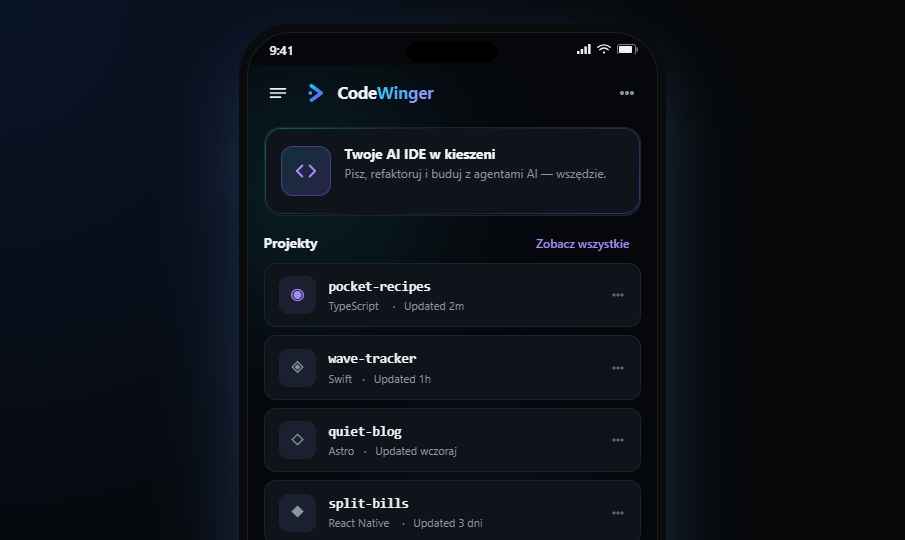
CodeWinger is designed to improve the net productivity equation — not just the raw generation speed, but the full cycle from prompt to reviewed, committed code. The architecture addresses the review tax directly:
- Full dev loop in one workspace reduces context switching between editor, terminal, Git, and preview — the transitions that silently eat developer time.
- Inline diff review at generation time means you inspect and accept changes as the agent produces them, catching issues before they compound into review debt.
- BYOK removes subscription cost from the ROI calculation. When you bring your own API key, you pay only for what you use and can switch providers without changing tools.
- Terminal, Git, and LSP integration keep the feedback loop tight so generated code can be tested, committed, or rejected without leaving the workspace.
- Local-first privacy means your project files and prompts stay on your machine, removing a variable from enterprise ROI discussions about data handling.
The goal is not to inflate the productivity number. The goal is to make the real 19.3% gain as friction-free as possible by reducing the review tax, the context-switching cost, and the subscription overhead that eat into net value.
Try it
Download CodeWinger Desktop for Windows x64
CodeWinger Desktop 0.3.0 is available free today. Use the setup installer for the normal Windows installation path. The MSI is available for administrators or managed deployments.
Bottom line
AI coding tools deliver real productivity gains, but the real number is 19.3%, not 10x. The 3.6 hours saved per week on routine coding are genuine. The 11.4 hours spent reviewing AI output are also genuine. The difference between teams that benefit from AI tools and teams that just produce more unreviewed code is how they handle the review tax and how honestly they measure outcomes.
Measure time-to-feature, defect rate, and review time. Ignore lines-of-code metrics. Use AI tools where they are strong — routine patterns, boilerplate, scaffolding, documentation — and apply human judgment where they are weak — architecture, novel debugging, security, complex business logic. The productivity is real. The 10x is not.
FAQ
How much productivity do AI coding tools actually deliver?
Survey data shows 90% of engineering leaders report gains, but controlled studies find a net average improvement of around 19.3%. The gap comes from how productivity is measured: self-reported perception versus actual output metrics like time-to-feature and defect rates.
Where does the 19.3% productivity figure come from?
The 19.3% net gain is derived from aggregating multiple controlled studies that measure developer output before and after AI tool adoption, adjusting for the additional review and debugging time that AI-generated code requires.
How much time do developers spend reviewing AI-generated code?
Recent data indicates developers spend an average of 11.4 hours per week reviewing AI-generated code. This review tax partially offsets the raw speed gains from AI code generation, making it one of the most important hidden costs of AI-assisted development.
How should teams measure AI coding ROI honestly?
Measure time-to-feature, defect rate, and review time rather than lines of code. Lines of code is a vanity metric that AI tools inflate without necessarily improving project outcomes. Track the full cycle from prompt to production-ready merge.
Are 10x productivity claims from AI coding tools realistic?
Not for general development work. The 10x claim applies at best to narrow tasks like boilerplate generation or test scaffolding. For real projects involving architecture, debugging, security, and review, the net gain is closer to 19.3% on average.
How does CodeWinger help with AI coding productivity?
CodeWinger reduces the review tax by showing inline diffs at generation time so developers catch issues before they compound. The full dev loop in one workspace reduces context switching, and BYOK removes subscription cost from the ROI equation.